
Visa 482: Seven Survival Checkpoints & Agent Vetting Guide
When starting to look for a migration agency to lodge a Subclass 482 visa application, a common habit for many clients is to post on Facebook community groups to gather information about agents. It is easy to encounter familiar questions such as: “Has anyone ever applied through this agency? Could you please give me a review?”, “Does anyone have information about this agent? I’d appreciate a review”, or “Is this agent reputable, guys? I need some reviews before applying for the 482 visa.”
Indeed, real-world experiences from predecessors are always a helpful source of reference. However, clients should also note that the social media landscape today largely consists of uncertified information, while harboring significant risks as fake accounts or disguised seeding teams run rampant to steer public opinion and fish for clients. While genuine shares still exist, please remember that someone else’s visa success can never serve as a guarantee of safety for your own case.
An agency heavily praised online does not mean your application is guaranteed to be safe. The most vital rule to keep in mind: When an application encounters issues or breaches immigration laws, you—not the online community or the agent—are the one who will bear the full consequences regarding time, financial loss, and your future pathway to Australian permanent residency.
At MK Lees, we always recommend that social media reviews should only serve as a basic reference. To proactively protect yourself right from the initial service selection stage, you must thoroughly understand the legal framework and learn how to control critical checkpoints within your own visa application dossier.
Part 1. Understanding the Legal Process of the Employer-Sponsored Visa (Subclass 482)
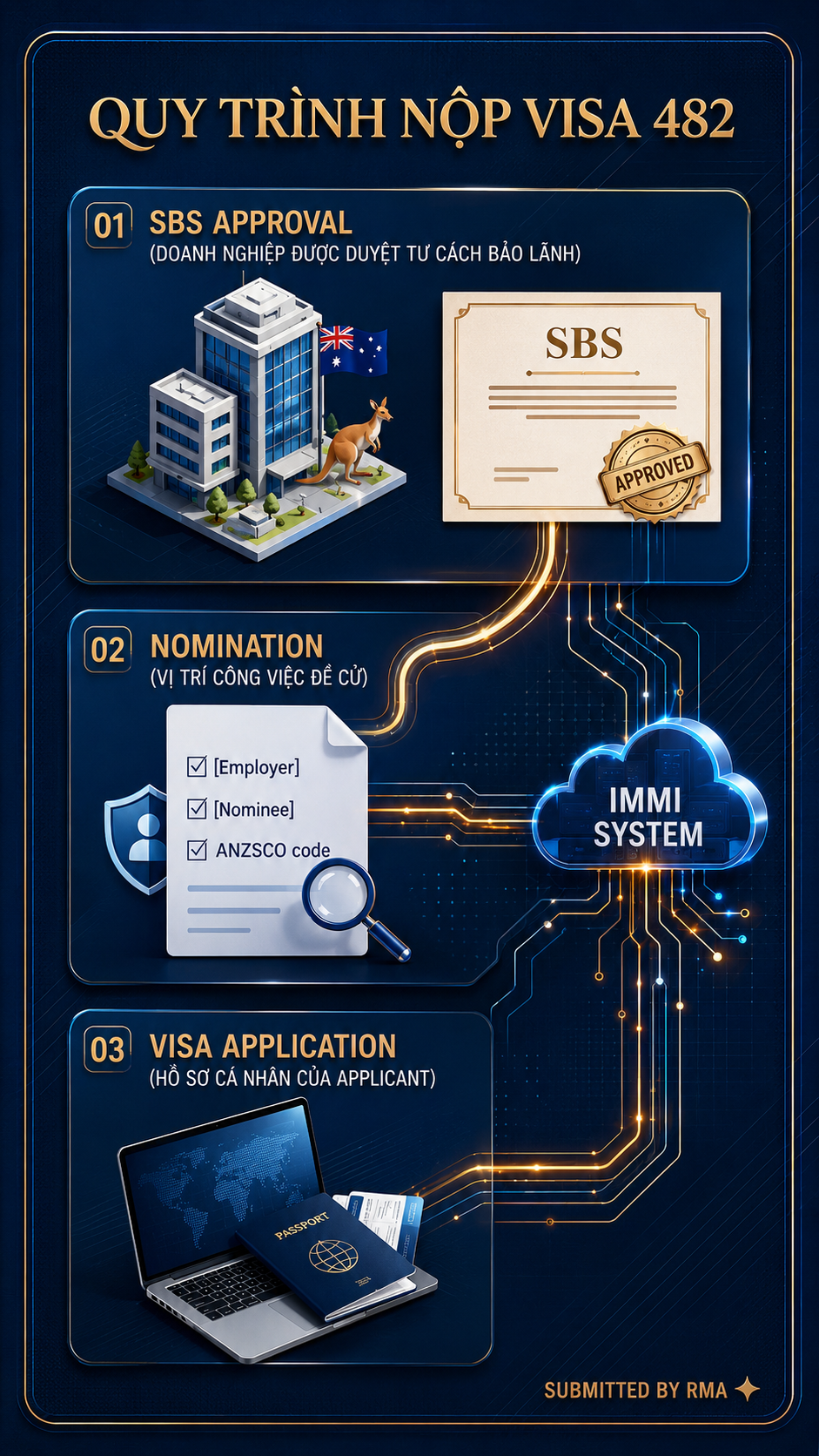 Visual diagram of the 3 core legal steps in the Employer-Sponsored Visa (Subclass 482) application process.
A standard Subclass 482 visa application is not a one-off document submission, but rather a sequence of three independent yet interconnected legal stages processed within the Department of Home Affairs systems:
Step 1: Sponsorship Approval (Business Sponsorship Application)
Core Nature: The Department of Home Affairs assesses the legal capacity, financial viability, and lawful operation of the sponsoring business to determine if it meets the legal requirements to sponsor overseas workers.
Result: Standard Business Sponsorship (SBS) Approval Notice confirming that the business is officially approved to sponsor overseas workers.
Step 2: Nomination Application (Position Nomination by Business)
Nature: The business submits a nomination application for a specific position tied to an occupation, salary, and working conditions for a specific employee (Nominee). This is the single most critical factor defining your job and is directly linked to Visa Condition 8607 (the mandatory condition requiring employees to work strictly in the approved position and occupation, for the sponsoring employer only, and not switch to another occupation without Department of Home Affairs approval).
Result: Nomination Approval Notice (The official notice confirming that the Australian Department of Home Affairs has approved the position and occupation nominated by the business for the applicant).
Step 3: Visa Application (Applicant’s Visa Lodgement – Usually Prepared by an RMA)
Core Nature: You lodge your individual visa application to prove that you fully satisfy the standard criteria regarding professional qualifications, work experience, English language proficiency, health, and character to undertake the nominated position from Step 2.
Outcome: Visa Application Acknowledgement, Application ID/TRN, and the Visa Grant Letter (Final outcome).
Once you grasp the 482 visa workflow, you will realize that the core elements determining application success do not merely lie in the expertise of the migration agent/RMA and the candidate’s profile quality, but fundamentally depend on two core legal elements from the employer’s side: a genuine sponsor and a genuinely required nominated occupation, accompanied by absolute transparency of information throughout the implementation process.
Part 2. Differentiating Key Terminology in Subclass 482 Applications
During the visa process, many applicants frequently confuse the various legal stages. Please master these core distinctions:
Employment Contract: A binding employment agreement signed between you and the sponsoring business, outlining employment terms, remuneration, employing entity, and working conditions.
Nomination: The employer’s application nominating a specific occupation and position for a designated nominee.
Nomination Approval: The official notice of approval issued by the Department of Home Affairs once the nomination application is successfully granted.
Visa Application: The applicant’s formal application for the substantive visa.
Visa Acknowledgement: An official departmental confirmation verifying that the visa application has been received.
Visa Grant Letter: The official notification letter confirming that the visa has been granted.
IMPORTANT NOTE:
- ⚠️ Nomination (the business’s position nomination application) IS COMPLETELY DIFFERENT FROM Visa Application (your personal visa application).
- ⚠️ Visa Application Lodged (the visa application has been submitted to the system) IS DIFFERENT FROM Visa Approved (the visa application has been approved).
- ⚠️ Visa Acknowledgement (confirmation receipt from the Department of Home Affairs) IS NOT Visa Grant Letter (the official visa grant notice).
- ⚠️ Having a sponsoring business DOES NOT MEAN your visa application will definitely be granted (because the personal profile and nominated position are assessed separately).
Part 3. Seven Vital Checkpoints for Your Subclass 482 Application
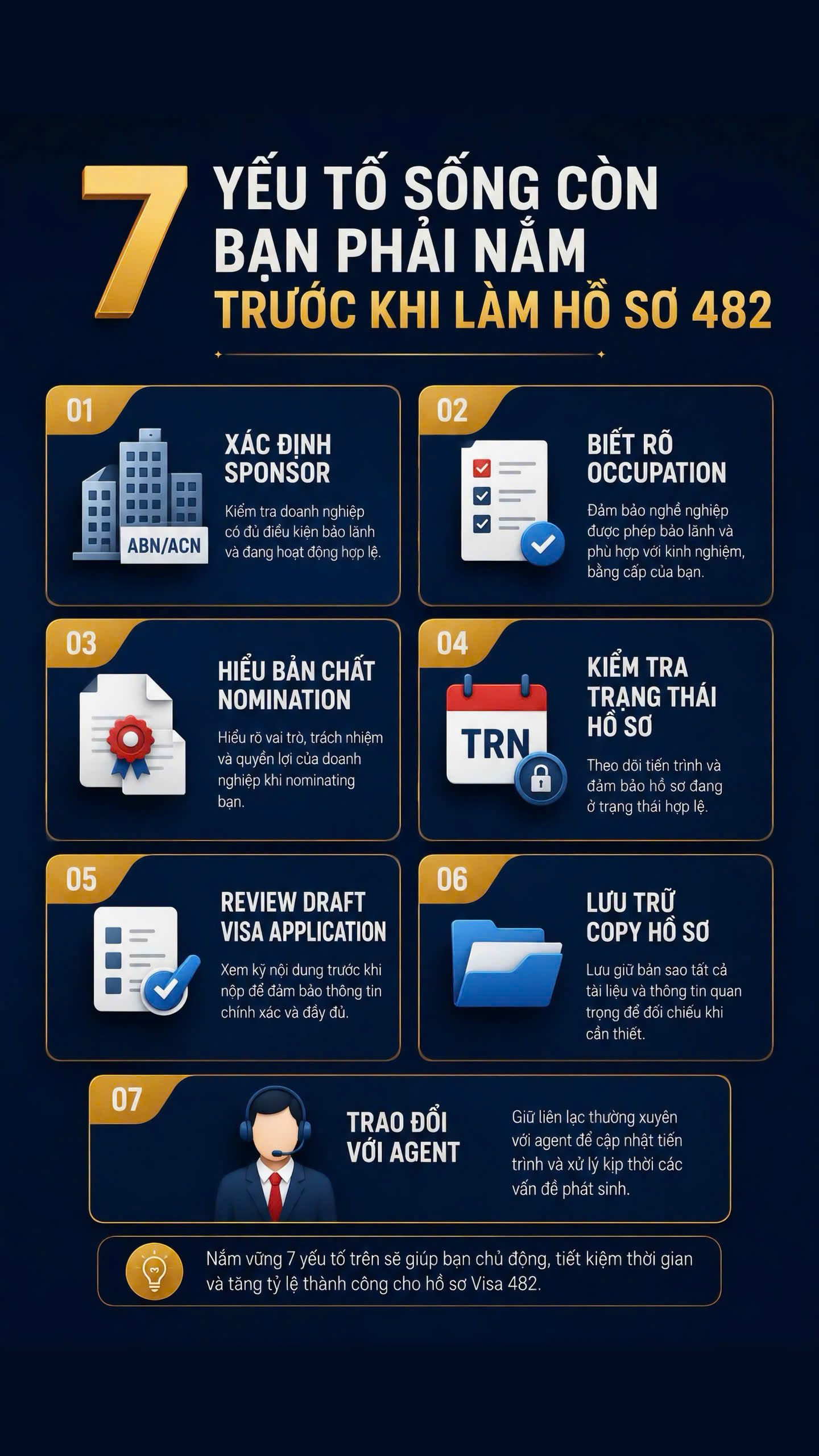 Summary of the 7 survival checkpoints empowering applicants to control and safeguard their skilled visa dossier.
Building upon the regulatory framework above, from the professional perspective of a migration practice, MK Lees advises you to independently verify 7 critical checkpoints to guarantee absolute transparency:
First: Precisely identify your Employer and Sponsor legal entity
Do not rely solely on trading names or public storefronts. You must verify the exact legal entity, Australian Business Number / Company Number (ABN/ACN), registered address, and actual workplace location. A reputable agent will guide you on how to search government registries to confirm the business is actively trading. These corporate details must completely align across your Employment Contract, nomination approval, and physical workplace.
Second: Confirm your exact nominated Occupation code
Never settle for loose, generalized occupational descriptions. You must know your exact occupational title and standard ANZSCO code, mapping them cleanly across the chain: Nominated occupation => Position Description => Employment Contract => Actual daily duties.
Third: Understand the true legal nature of a Nomination
A nomination is not merely a generic company sponsorship registration; it serves as a strict tripartite legal bridge: EMPLOYER => POSITION/OCCUPATION => NOMINEE. Although the final outcome letter (Nomination Approval Notice) from the Department of Home Affairs only briefly summarizes the details of the sponsoring business (Sponsor), the nominated worker (Nominee), the file number, and the TRN, all substantive metrics covering salary, position details, and core tasks must be meticulously declared and rigorously assessed during the initial nomination stage. Remaining completely blind to your sponsored salary or nominated position structure points to a severe transparency failure.
Fourth: Verify Nomination and Visa Application statuses
Always draw a clear line between applications lodged versus applications approved. Require your agent to supply official TRNs, Visa Application Acknowledgement letters, and milestone tracking updates.
Fifth: Review your Visa Application draft prior to submission (“What has my agent lodged on my behalf?”)
Your application should never be a “black box” where you are completely in the dark and forced to passively wait for the outcome. A transparent agent will always supply a complete Visa Application draft summary allowing you to independently cross-check your personal particulars, employment history, qualifications, English test results, payslips, and supporting documentation to ensure zero discrepancies prior to final lodgement.
Sixth: Proactively verify your visa status via VEVO upon grant
Upon receiving notification of visa grant from your agent, do not rely exclusively on PDF attachments; you must independently authenticate your visa validity through the official Australian Government system – VEVO (Visa Entitlement Verification Online).
Core elements requiring rigorous verification via VEVO include:
Visa Class and Subclass: Must display the correct visa stream.
Visa Expiry Date: The legal validity period of your stay.
Visa Status: Status must explicitly indicate In Effect or Active.
Visa Conditions: All mandatory visa conditions, noting particularly Condition 8607 (mandating employment exclusively with your approved sponsor, within the approved occupation, prohibiting unauthorized employment termination or position transfers) and Condition 8501 (requiring the maintenance of adequate health insurance throughout your stay in Australia).
How to check via VEVO: You can download the myVEVO mobile application or access the official VEVO portal online via the Department of Home Affairs website. You will need standard identification details: Passport number, Date of birth, nationality, and either a Transaction Reference Number (TRN) or Visa Grant Number. Manual verification via VEVO provides the ultimate security check ensuring your legal working rights in Australia free from “ghost visa” risks or data errors.
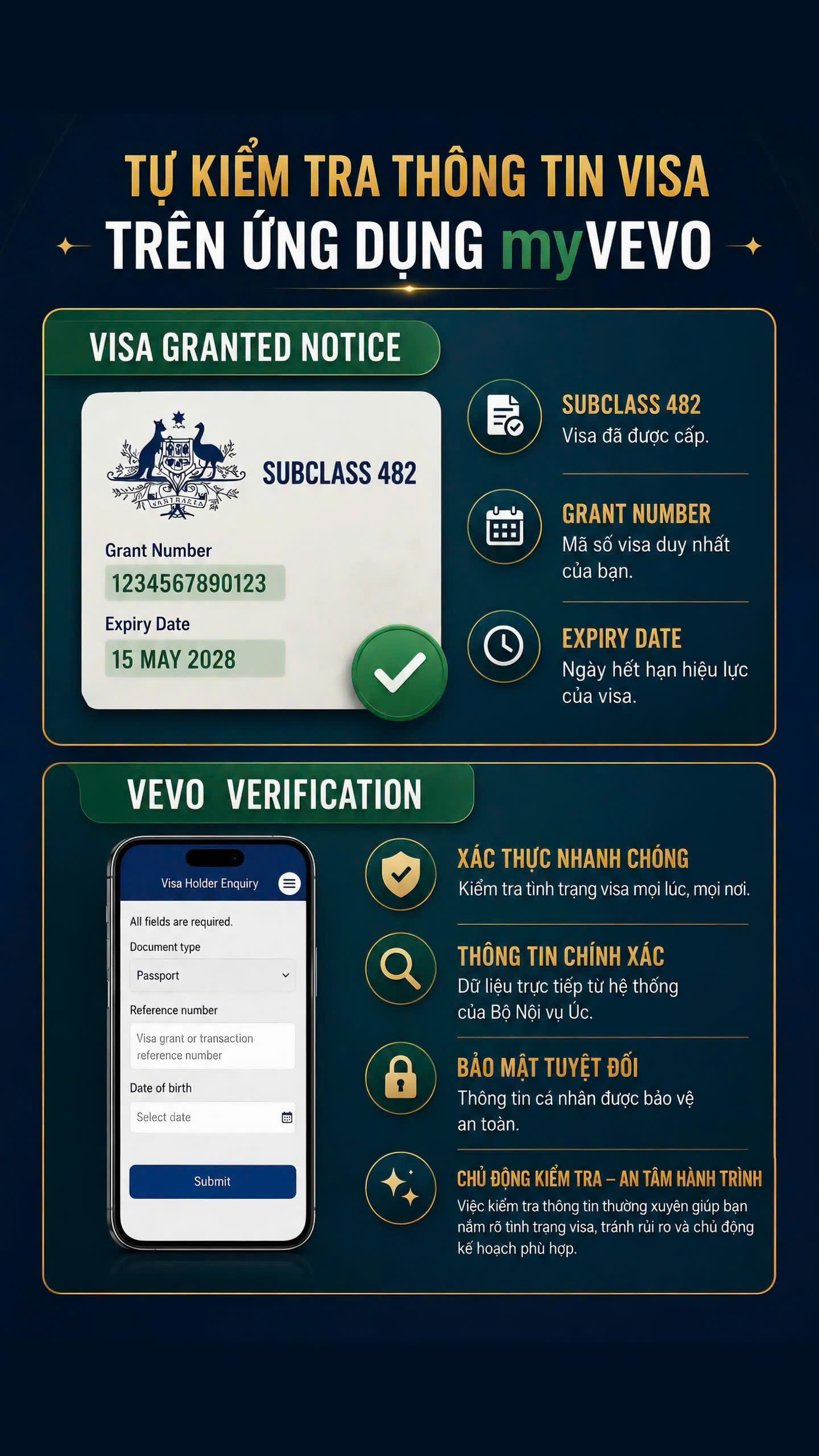 Visual illustration of the myVEVO mobile interface, enabling straightforward self-verification of visa status, expiry dates, and attached conditions.
You can directly access the Australian Government’s official verification system at the Australian Government Visa Entitlement Verification Online (VEVO) Portal.
Seventh: Maintain full copies of your complete personal application dossier
You should actively retain secure backups of all vital documents including employment contracts, position descriptions, visa application drafts, acknowledgements, TRNs, submitted personal evidence, and the official visa grant letter for future reference.
Part 4. The Golden Questionnaire to Test Your Migration Agent’s Transparency
Before committing to a service agreement with any migration agent, you maintain the absolute right to demand clear answers to the following questionnaire:
Who will be my sponsoring employer / legal entity? — Who is my official sponsoring company? What are their exact legal entity name, ABN, and ACN?
Generally, precise sponsor corporate data (including legal entity, ABN, and ACN) is supplied after you successfully clear employer interviews and secure an official Job Offer. A reputable agent will direct you to official government verification tools to confirm active corporate trading status. These metrics must match your employment contract, nomination filings, and workspace operations.
What occupation and ANZSCO code am I being nominated under? — Under what precise occupational title and ANZSCO code am I being nominated?
What is my position, salary and workplace? — Do my employment contract and job offer transparently state the company details, job title, Position Description tasks, salary structure, and actual workplace location?
Has my nomination been lodged? If yes, what is the current status and TRN? — Has my nomination application been lodged? If so, what is its current status and Transaction Reference Number (TRN)? Can I access tracking details?
Has my visa application been lodged? — Has my substantive visa application been formally lodged? Will I receive the official Department of Home Affairs Visa Application Acknowledgement and TRN to confirm filing?
Can I have a copy of my visa application summary and acknowledgement letter? — Can I review a draft or obtain a complete copy of my visa application summary to audit all personal declarations prior to final submission?
What supporting documents have been submitted on my behalf? — What supporting evidence files have been or will be compiled and uploaded on my behalf throughout the dossier?
Can you explain what stage my application is currently at and what happens next? — Could you outline precisely which stage my file currently occupies within the end-to-end workflow and detail the upcoming steps?
An professional, ethical migration practice will always understand and welcome these entirely legitimate inquiries from a diligent client seeking full oversight of their own file.
Part 5. Discovering Safe Settlement Solutions with MK Lees
Safeguarding your Australian migration future starts with choosing the right legal partner and maintaining full control over every milestone of your employer-sponsored visa journey. Do not let information gaps expose you to regulatory risks in a high-compliance framework.
Comprehensive Strategic Advisory: Work directly with seasoned migration professionals to ensure absolute transparency across every stage from Sponsorship and Nomination to Visa Application.
100% Dossier Control: Receive complete draft copies, TRNs, and real-time visibility over personal file progression inside Department of Home Affairs systems.
Contact MK Lees today for a complimentary file assessment and to establish a secure, robust employer-sponsored visa pathway!