
Warning: The Visa 866 Trap & Safe Australia PR Pathways
Australia today is no longer the same as it was 50 years ago. The doors to immigration remain open, but the standards have shifted from “compassion” to “value contribution”.
To help our clients gain the most realistic perspective on their chosen pathways, MK Lees Immigration would like to share an inspiring article from The Guardian about Mr. Lam Tac Tam’s 50-year settlement journey, while also analyzing the transformation of Australia’s immigration policy over the past half-century. These are valuable, real-world insights that clearly illustrate why thorough preparation in terms of skills and a strong work ethic are the only keys to sustainable settlement today.
REFERENCE SOURCE:
Original article title: Fifty years on, Lam Tac Tam reflects on life in Australia as the first Vietnamese refugee to arrive by boat
Author: Bertin Huynh
Published date: 25/04/2026 on The Guardian
Article link: View here
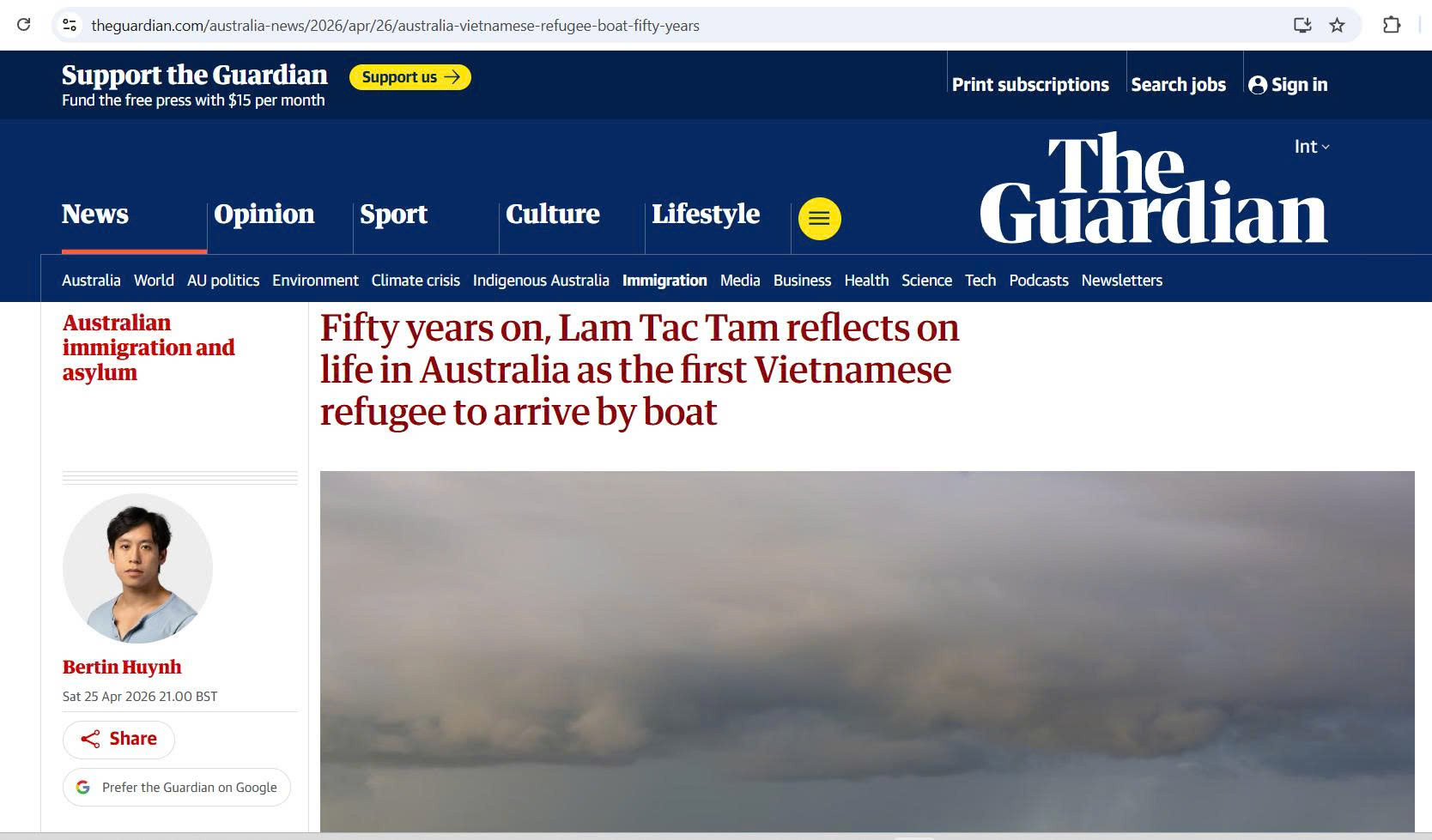 A 50-year immigration milestone: An article detailing the journey of the first Vietnamese people to arrive in Darwin, through the lens of The Guardian.
1. The settlement journey of the first generation and their philosophy of survival
Exactly 50 years ago, the Kien Giang fishing boat docked in Darwin, carrying Mr. Lam Tac Tam — one of the first Vietnamese to settle in Australia by sea.
Despite coming from a well-off business family in Saigon, Mr. Tam completely discarded any notion of a life of leisure the moment he set foot in this new land. After just one week of arriving, he and his friends immediately went looking for work because they “didn’t want to be a burden on the local community.”
He shared a harsh but deeply proud reality:
“When I came to Australia, we just worked, worked, worked, and worked.”
From someone who had never experienced physical hardship back home, he took on all sorts of jobs, from construction during the day to moonlighting at restaurants at night. This relentless hustle was the true passport that allowed him to build a life in Australia for half a century.
2. The shift in Australia’s immigration policy (1976 – 2026)
The Guardian article provides an objective look at how the Australian Government has changed its attitude towards immigrants over time, drawing on the profound analysis of Dr. Claire Higgins — a historian and senior research fellow at the Kaldor Centre for International Refugee Law at UNSW.
According to Dr. Higgins, a pivotal turning point occurred in the 1980s: economic downturns and changes in leadership hardened Australia’s stance on immigration. Australia began to transition from an intake based on humanitarian support to a highly strategic, economic-driven immigration system.
She emphasized that Australia’s current policies are defined by strict control and extremely rigorous processing systems, a stark contrast to the landscape of 50 years ago:
Quote from Dr. Claire Higgins (Historian of immigration law):
“In 1976, Prime Minister Malcolm Fraser believed that a compassionate Australia had to support refugees… However, since the 1980s, economic downturns and leadership changes have made the attitude towards asylum seekers much harder. Today, Australia’s policy is defined by mandatory detention and offshore processing — a system that is incredibly costly and strict.”
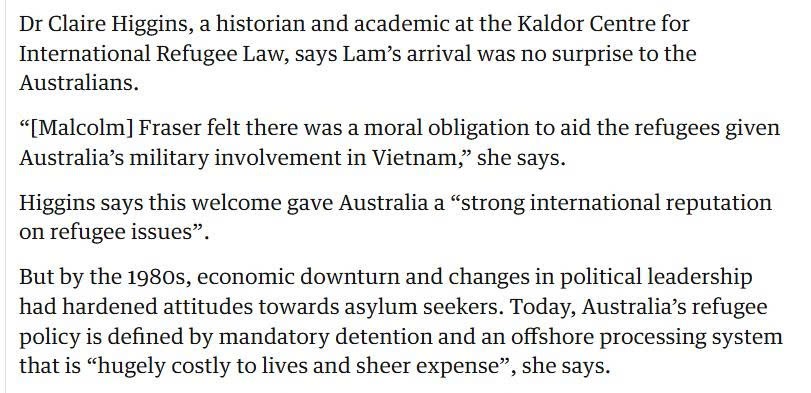 Dr. Claire Higgins’s analysis of the shift from “compassion” to the Australian Government’s strict immigration control strategies.
3. 2026 Australian Immigration Policy Updates: Key Takeaways
Given this historical evolution, those currently harboring dreams of settling in Australia must understand that “the rules of the game” have completely changed. The Australian Government no longer opens its doors based purely on compassion, but rather on actual capability to contribute:
- Prioritizing skills and qualifications: Australia now focuses heavily on highly skilled applicants with professional degrees and strong English proficiency (IELTS/PTE) who can immediately contribute to the economy.
- Tightening control over residency intent: Tourist, student, and family visitor visas are being scrutinized more rigorously than ever. The goal is to ensure applicants comply strictly with their visa conditions, showing zero tolerance for those using temporary visas as a “backdoor” to work illegally.
Refer to the official regulations and policy updates from the Australian Government:
• New Migration Strategy
• Current strict English language requirements
• Latest official immigration news and updates
4. Warning: The Risks of the Australian Protection Visa (Subclass 866) “Trap”
Recently, MK Lees Immigration has received numerous inquiries from clients regarding applying for an Australian Protection Visa (Subclass 866) as a solution for long-term stay. Through this article, we strongly urge our clients to stay highly alert and be cautious of misleading “traps” in the market:
Legally, the Protection Visa (Subclass 866) is a permanent visa for individuals who have entered Australia legally but cannot return to their home country due to a well-founded fear of persecution. However, current realities show a trend of many applicants intentionally misusing this visa: they enter on a short-term visa (tourist, visiting relatives, etc.) and then file an asylum claim solely to obtain a Bridging Visa. Their ultimate goal is to prolong their stay and exploit work rights, rather than genuinely seeking legal protection.
View detailed regulations on the Subclass 866 Protection Visa on the Australian Government website
Common Mistakes and the Harsh Reality:
- Misguided intent: Many people apply for the Protection Visa (Subclass 866) simply to secure a Bridging Visa, aiming to take advantage of work rights during the processing period.
- Sophisticated screening systems: The Australian Government now cross-references applications meticulously against real-world conditions using in-depth country information reports. Claims lacking factual basis are rejected in a very short amount of time.
Legal Consequences that “Lock Down” Your Future:
- Section 48 Bar: Once you apply for a Subclass 866 visa and are refused, this legal provision prevents you from applying for most other substantive visas (such as student, partner, skilled, or investment visas) while remaining in Australia.
- Entry bans: Abusing the immigration system will lead to deportation and carries the risk of permanent entry bans, completely destroying any chance of returning to Australia in the future.
5. Building a Sustainable and Transparent Australian Immigration Pathway in 2026
Looking back over the 50-year journey, we see an Australia that no longer opens its doors based purely on compassion. It is a nation of rigorous standards that highly values honesty and transparency.
If you want to settle sustainably in Australia, prepare a legitimate pathway based on your actual capabilities and a genuine work ethic.
Do you want to build a realistic immigration pathway that aligns with current policies? Contact MK Lees Immigration for the most transparent roadmap consultation.