
Australia Skills Assessment 2026: Requirements & Process Guide
In the Australian Skilled Migration pathway, a Skills Assessment (SA) is considered the mandatory “starting line.” It is the regulatory process used to determine if your qualifications and work experience meet the rigorous labor standards required to work in Australia.
Rather than having the Department of Home Affairs evaluate technical skills themselves, the Australian Government delegates this authority to specific professional bodies (Assessing Authorities) to conduct a thorough vetting process before you can proceed with your visa application.
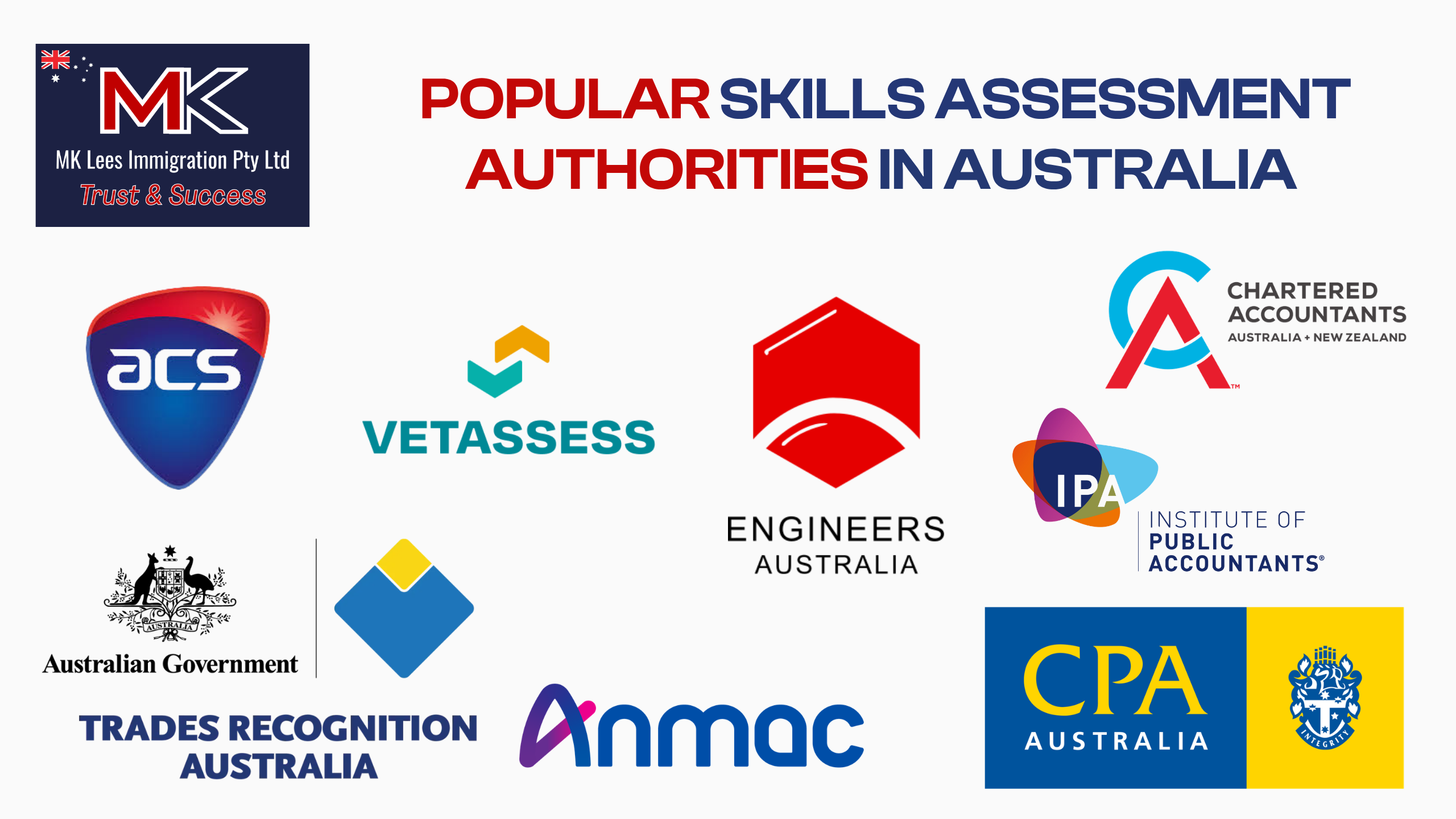 Key Assessing Authorities are mandated by the Australian Government to conduct Skills Assessments for visa applicants.
I. Why is a Skills Assessment the “Bedrock” of Your Migration Pathway?
If a migration file were a building, the Skills Assessment would be its foundation. It serves as your “professional birth certificate”—the only legal basis upon which the Australian Government recognizes you as a skilled worker. Depending on your goals, SA plays a strategic role in two main pathways:
1. For Points-Tested Skilled Migration Visas (GSM – 189, 190, 491)
- Mandatory Threshold: You cannot lodge an Expression of Interest (EOI) without a valid, successful Skills Assessment.
- Basis for Points: The SA determines your “Skilled Date”—the critical factor used by the Department of Home Affairs to calculate your points for work experience and issue an Invitation to Apply (ITA).
2. For Employer-Sponsored Visas (482, 494, 186)
- Visa 494 & 186 (Direct Entry): A Skills Assessment is 100% mandatory to prove your expertise meets Australian standards before a business can sponsor you.
- Visa 482 (TSS): Requirements vary based on occupation and nationality. For Trades and Vietnamese nationals, a Skills Assessment is generally a mandatory requirement to demonstrate competency to the Department of Home Affairs.
II. REALITY CHECK: COMMON MISCONCEPTIONS ABOUT SKILLS ASSESSMENT
Based on our extensive field experience at MK Lees Immigration, we have identified several misconceptions that often lead to avoidable visa refusals. Please take note of the following to protect your migration strategy:
There is a widespread misunderstanding that simply graduating in Australia and having one year of local work experience grants an automatic exemption.
The Reality: SA exemptions are far from automatic and highly complex. Eligibility depends on a combination of your ANZSCO code, visa stream, and specifically the employer’s corporate profile (Sponsor). Only a professional MRA, after a thorough assessment of the sponsor’s specific documents, can determine whether an SA is required in your case. Therefore, proactively obtaining your SA is the most strategic move, ensuring you are “visa-ready” to seize any opportunity the moment a suitable sponsor appears.
It is vital to understand that the Assessing Authority (AA) and the Department of Home Affairs (DHA) are two independent bodies with different criteria.
- Assessing Authority (AA): Focuses solely on technical competency (Are you skilled enough to perform the job?).
- Department of Home Affairs (DHA): Focuses on legality and genuineness (Is the job real? Are taxes and social security paid according to the law?).
A file with a successful SA can still be refused by DHA if the “genuineness of employment” cannot be proven through third-party evidence.
Risk regarding Social Insurance (BHXH) for Vietnamese applicants: Some authorities may issue an SA based on paperwork alone (Contracts, Payslips, Reference letters). However, during the visa stage, DHA considers Social Insurance records the most critical evidence to verify paid employment. If you hold an SA but cannot provide corresponding Social Insurance records, DHA reserves the right to refuse the visa on the grounds of non-genuine employment, regardless of your assessment result.
III. SKILLS ASSESSMENT ELIGIBILITY
Whether you are applying from within Australia or from Vietnam, eligibility requirements differ regarding evidence and years of experience:
1. For Offshore Applicants (From Vietnam)
- Work Experience: Generally requires 3 to 5 years of full-time experience. For those with qualifications in an unrelated field (e.g., an Accounting degree but working as a Chef), a minimum of 5 years is typically required.
- Financial Evidence: To prove paid employment under migration law, you must provide: Social Insurance records (BHXH), Personal Income Tax (PIT) finalization, and bank statements showing salary transfers.
- English Requirements: Varies by authority. Bodies like Engineers Australia (EA) require IELTS/PTE at the time of SA lodgment, while others like VETASSESS may allow submission later.
2. For Onshore Applicants (In Australia)
- Work Experience: The primary advantage for Australian graduates is that they often only require **one year** of post-qualification work experience to be eligible for an SA.
- Financial Evidence: Highly reliable evidence through the Australian Tax system (TFN/ABN) and Superannuation records.
- English Requirements: Must comply with the specific regulations of the authority managing that occupation code.
IV. THE 3-STAGE SKILLS ASSESSMENT PROCESS FOR TRADES
Unlike office-based roles, technical trades require a rigorous three-stage assessment to ensure the applicant is truly “job-ready” by Australian standards:
Stage 1: Documentary Evidence Assessment
This is the initial screening where bodies like TRA or VETASSESS verify the authenticity of qualifications and experience. Employment Reference Letters must use precise Australian technical terminology and align perfectly with ANZSCO standards.
Stage 2: Technical Interview
A theoretical exam and direct interview with an Australian assessor to test your professional mindset. This is conducted online via Zoom or Skype and involves scenario-based questions regarding Occupational Health and Safety (OH&S), machinery operation, and troubleshooting.
Stage 3: Practical Demonstration
A hands-on challenge of your trade skills under the supervision of an assessor at designated testing centers (located in Vietnam or Australia).
V. POPULAR SKILLS ASSESSMENT AUTHORITIES IN AUSTRALIA
The authority you apply to depends entirely on your specific ANZSCO code:
1. Trades and Technical Sectors
- TRA (Trades Recognition Australia): For trades such as Chefs, Electricians, Mechanics, Welders, etc. TRA Website
- VETASSESS: The largest authority, assessing a diverse range from Marketing and Management to Agricultural technicians. VETASSESS Website
2. Engineering and IT Sectors
- Engineers Australia (EA): Solely for the Engineering block (Mechanical, Civil, Electrical, etc.). EA Website
- ACS (Australian Computer Society): For the Information Technology (IT) sector. ACS Website
3. Accounting, Finance, and Healthcare
- Accounting Block: CPA Australia, CA ANZ, or IPA.
- ANMAC (Australian Nursing & Midwifery Accreditation Council): For Nurses and Midwives. ANMAC Website
VI. STRATEGIC ADVICE FROM MK LEES IMMIGRATION
A Skills Assessment is not merely a paperwork exercise; it is a strategic migration maneuver. To ensure your file is on the right track from day one, we provide two core recommendations:
Loding a file without deep migration law expertise carries high risks. The Migration Representative/Agency (MRA) team at MK Lees will help you:
- Ensure ANZSCO Alignment: We analyze your Job Description to find the most advantageous occupation code. A minor discrepancy can lead to a refusal.
- Professional Portfolio Mapping: MK Lees assists in auditing and preparing a chain of evidence (Social Insurance, Tax, Reference Letters) that is undeniable and meets the strictest criteria.
Holding a successful SA early gives you an absolute competitive edge:
- Seize Instant Opportunities: Be ready to lodge your visa the moment you find a sponsor or when State/DAMA programs open unexpectedly.
- Proactive Stance with Employers: Don’t make an employer wait 3-4 months for an assessment. Being “visa-ready” ensures you don’t lose the best opportunities to other candidates.
“Australian Migration leaves no room for trial and error. A refused Skills Assessment costs more than just money—it costs you a life-changing opportunity.”
The expert team at MK Lees Immigration is always ready to accompany you to ensure your pathway is safe and efficient.
CONTACT MK LEES FOR A 1-ON-1 STRATEGIC CONSULTATION