
ANZSCO Guide: Key to a Successful Skilled Visa
Are you preparing your migration application or applying for a Skilled Visa to Australia or New Zealand? Accurately determining your ANZSCO code is the first and most critical step. Don’t let a confusion over your occupational classification affect the outcome of your Skills Assessment or your visa application!
In this detailed ANZSCO DECODING article, MK Lees Immigration will provide you with a comprehensive overview, highlight the importance, and give you a detailed guide on how to read and look up the most accurate ANZSCO code for a successful Australian permanent residency application!

I. What is ANZSCO? (Australian and New Zealand Standard Classification of Occupations)
ANZSCO stands for the Australian and New Zealand Standard Classification of Occupations (Phân loại Tiêu chuẩn Nghề nghiệp Úc và New Zealand).
It is a common classification system utilized by the statistical and immigration authorities in both Australia (Department of Home Affairs) and New Zealand. Its purpose is to categorize all occupations within the labour markets of both nations into a unified structure, based on the required tasks, duties, and skill levels.
II. Why is the ANZSCO Code Critical for Your Skilled Visa Application?
The ANZSCO code is not just a number; it is a key factor in your Skilled Visa application process because:
- Determining Eligibility: The ANZSCO code dictates whether your occupation is included on the Skilled Occupation Lists (SOL) of Australia or New Zealand.
- Skills Assessment: The relevant skills assessing authority will use the ANZSCO code to compare your qualifications, experience, and actual job duties against the standardized requirements of the nominated occupation. If your work does not align, the application may be refused.
- Defining Skill Level: Every ANZSCO code comes with a Skill Level ranging from 1 to 5, which determines the minimum educational attainment and/or professional experience you must possess.
III. Detailed Guide to the 6-Digit ANZSCO Code Structure
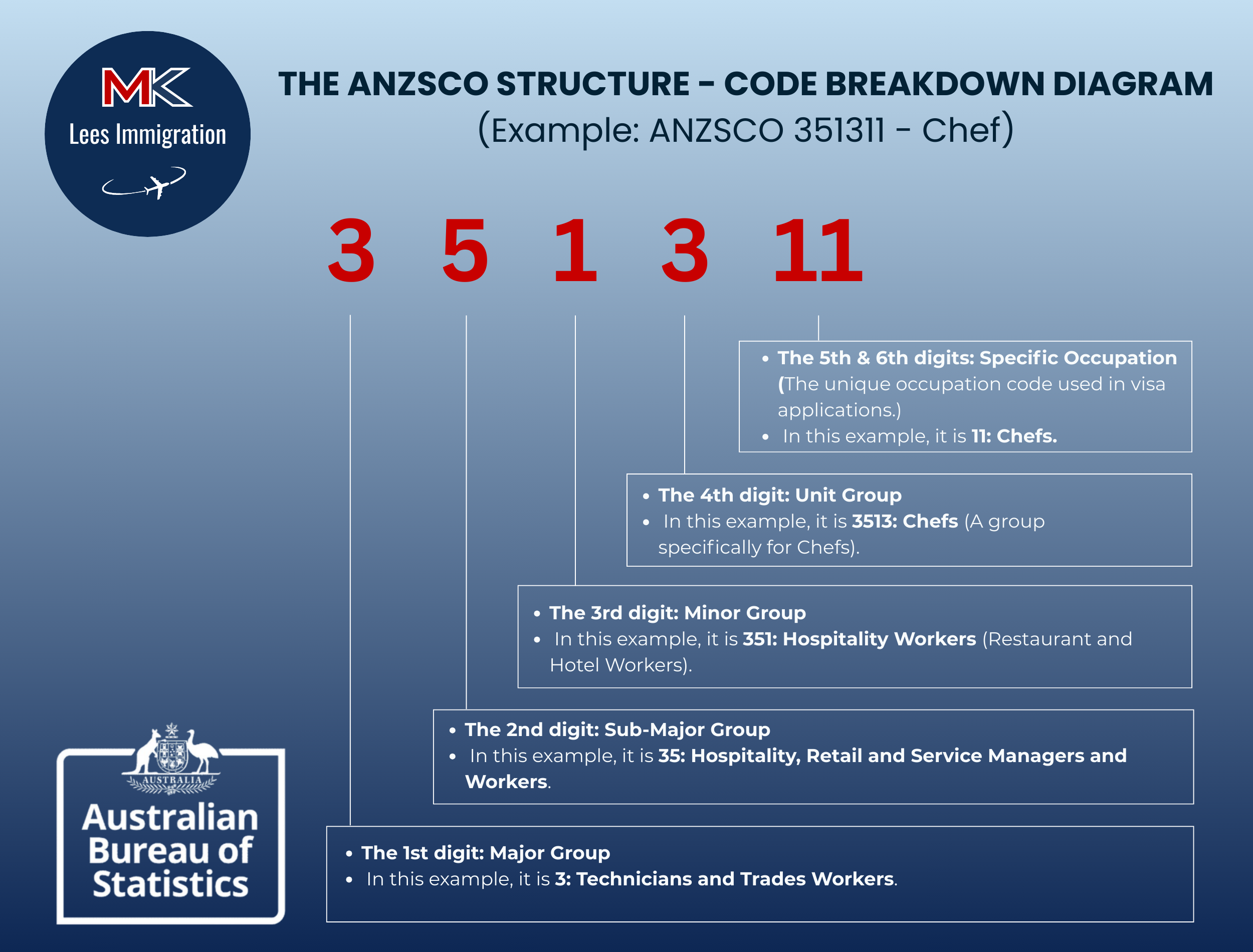
The ANZSCO code is a 6-digit numerical string organized hierarchically from the general to the specific.
1. Meaning of the Overall 6-Digit ANZSCO Structure
Each numerical position represents a level of classification:
- 1st Digit (e.g., 3): Major Group – The broadest classification of occupations.
- 2nd Digit (e.g., 5): Sub-Major Group – A breakdown of the Major Group.
- 3rd Digit (e.g., 1): Minor Group – A further subdivision of the Sub-Major Group.
- 4th Digit (e.g., 3): Unit Group – A collection of occupations with similar skill sets and tasks.
- 5th & 6th Digits (e.g., 11): Specific Occupation – The unique occupation code used in visa applications.
2. Meaning of the First Digit (Major Group)
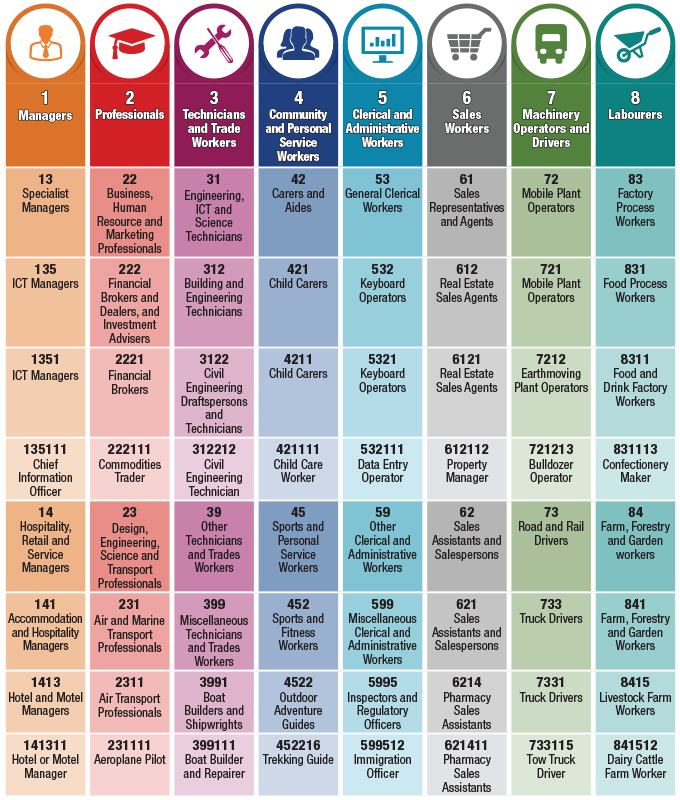
The first digit (position 1) identifies the Major Group of the occupation, providing a general overview of the field and skill level:
- 1 – Managers Includes occupations responsible for planning, organizing, coordinating, and controlling the operations of a company, department, or branch. Examples: Chief Executive Officers (CEO), Construction Managers, Hospitality Managers.
- 2 – Professionals Includes occupations requiring specialized knowledge, high-level qualifications (usually a Bachelor degree or higher), and the ability to apply theoretical concepts. Examples: Accountants, Engineers, Teachers, IT Professionals, Health Professionals.
- 3 – Technicians and Trades Workers Includes occupations requiring qualifications, certifications, or professional experience to perform complex technical and trade duties. Examples: Electricians, Plumbers, Chefs, Automotive Mechanics.
- 4 – Community and Personal Service Workers Includes occupations providing care, support, education, or amenities to individuals or communities. Examples: Aged Carers, Child Carers, Hairdressers, Fitness Instructors.
- 5 – Clerical and Administrative Workers Includes occupations performing administrative, office, and record-keeping tasks. Examples: General Clerks, Secretaries, Bookkeepers, Receptionists.
- 7 – Machinery Operators and Drivers Includes occupations operating industrial machinery or driving vehicles for transporting goods or passengers. Examples: Truck Drivers, Forklift Operators, Crane Operators.
- 8 – Labourers Includes occupations requiring minimal specialized skills, typically manual and supporting work in industries. Examples: Factory Hands, Cleaners, Farm Hands.
3. Specialization Analysis (2nd, 3rd, and 4th Digits)
The subsequent digits progressively narrow the scope to define the specialization of the occupation:
A. 2nd Digit: Sub-Major Group (Nhóm Phụ Chính)
- This digit broadly classifies the functional area within the major group.
- Example within Group 2 (Professionals): 21: ICT Professionals; 22: Business, Finance and Administration Professionals.
- Example within Group 3 (Technicians and Trades Workers): 31: Engineering, ICT and Science Technicians; 35: Hospitality, Retail and Service Managers and Workers.
B. 3rd Digit: Minor Group (Nhóm Nhỏ)
- This digit further narrows the occupational field within the sub-major group.
- Example continuing from Sub-Major Group 22: 221: Accountants, Auditors and Company Secretaries; 224: Policy and Planning Managers.
- Example continuing from Sub-Major Group 35: 351: Hospitality Workers.
C. 4th Digit: Unit Group (Nhóm Đơn vị)
- This digit creates the smallest group, covering occupations with the highest similarity in skill requirements and tasks. This is the most detailed level of classification before the specific occupation code.
- Example continuing from Minor Group 221: 2211: Accountants; 2212: Auditors, Company Secretaries and Corporate Treasurers.
- Example continuing from Minor Group 351: 3513: Chefs; 3514: Waiters.
4. Specific Code Example Analysis (Code 351311 – Chef)
To visualize this more clearly, let’s examine each digit in code 351311 – Chef:
- 1st Digit: 3 (Major Group) Technicians and Trades Workers
- 2nd Digit: 5 (Sub-Major Group) Hospitality, Retail and Other Services Managers and Workers
- 3rd Digit: 1 (Minor Group) Hospitality Workers
- 4th Digit: 3 (Unit Group) Chefs
- 5th & 6th Digits: 11 (Specific Occupation) Chef
5. Official Lookup Links (Australian Bureau of Statistics – ABS)
- The “Classification structure” page for detailed code lookups: Link to ABS Classification structure
- The “How ANZSCO works” page for understanding the concept, purpose, and scope: Link to ABS How ANZSCO works
IV. Skill Level: A Critical Independent Classification
1. Core Difference Between ANZSCO and NOC Canada
If you have researched Canadian migration, you’ll note a key difference between Australia’s ANZSCO and Canada’s NOC:
- NOC (Canada): Skill Level is Visible in the Code! The skill/training level, called TEER (Training, Education, Experience, and Responsibilities), is directly encoded by the second digit of the 5-digit NOC code. Example: In code 21200 (Software Developers), the ‘1’ in the second position corresponds to TEER 1 (typically requires a university degree).
- ANZSCO (Australia): Independent and More Detailed! The Skill Level is not one of the digits in the 6-digit ANZSCO code string. The first digit (1 to 8) only identifies the Major Group (e.g., 2 for Professionals, 3 for Trades Workers)—this is a broad classification, not the specific Skill Level. To determine if your occupation is Skill Level 1, 2, 3, 4, or 5, you must consult the detailed description for the entire 6-digit code on the Australian Bureau of Statistics (ABS) website.
In summary, for ANZSCO, Skill Level is a separate attribute assigned to the occupation, not integrated directly into the code structure like Canada’s NOC. This requires more care and detailed lookup when determining educational and experience requirements for Australian migration.
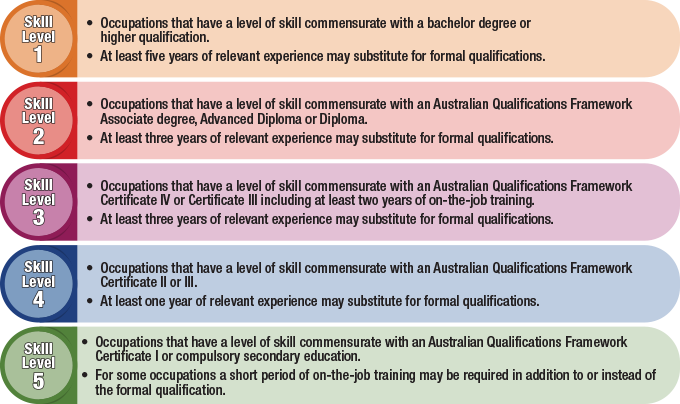
2. Classification of Skill Levels in ANZSCO
Here is an overview of the Skill Levels in ANZSCO and the common minimum requirements:
- Skill Level 1: Requires a Bachelor degree or higher. (Example: General Accountant – 221111).
- Skill Level 2: Requires an Associate Degree, Advanced Diploma, or Diploma. (Example: Engineering Technologist – 233914).
- Skill Level 3: Requires a Trade Qualification (Certificate IV/III) or at least 3 years of relevant work experience. (Example: Chef – 351311).
- Skill Level 4: Requires Certificate II or III or at least 1 year of relevant work experience. (Example: Hotel or Motel Receptionist – 541411).
- Skill Level 5: Requires Certificate I or short-term work experience. (Example: Kitchen Hand – 851311).
V. Accurate ANZSCO Code Lookup (ABS & Home Affairs)
The Australian Department of Home Affairs (DOH) requires you to select the correct ANZSCO code for the nominated occupation. However, for the official codes and detailed occupation definitions, you should consult the Australian Bureau of Statistics (ABS)—the official body managing ANZSCO. You then use that code to verify against the Skilled Occupation Lists (SOL) on the DOH website.
Steps to Look Up the ANZSCO Code:
- Access the Official ANZSCO Portal: Bạn nên tìm kiếm “ANZSCO ABS” trên Google, hoặc truy cập trang web của Australian Bureau of Statistics (ABS) tại liên kết sau:
Link tra cứu ANZSCO chính thức của ABS tại đây - Use the Search Function: Enter your job title (e.g., Software Engineer, Marketing Specialist, Chef) into the search box.
- Review Results and Description: The system will return a list of related occupations. Important: You must click on the 6-digit code to view the Occupation Definition.
- Match Job Duties: This is the most critical step. You must carefully read the Tasks Include and the Skill Level of the occupation. Only select the ANZSCO code if your actual job duties closely align with the ANZSCO description in the system.
- Check Validity on the Skilled Occupation List (SOL): Use the 6-digit code found to check on the Department of Home Affairs website to ensure it is on a valid Skilled Occupation List for your visa stream.
Link kiểm tra Skilled Occupation Lists (SOL) của Home Affairs tại đây
⚠️ Important Note from MK Lees Immigration:
Do not select the code based solely on the Job Title. The job title can vary between companies, but the actual job duties must match the ANZSCO description.
Always verify the code against the Skilled Occupation Lists (e.g., MLTSSL, STSOL, etc.) on the Department of Home Affairs website to ensure the ANZSCO code you select is valid for the visa you are applying for.
VI. Pathway from Visa 482 to Permanent Visa 186 (TRT)
The Skill Level of the occupation is highly important when transitioning from the temporary Visa 482 to the permanent Visa 186 (Temporary Residence Transition – TRT stream).
1. Standard Stream (Medium-term List)
- Skill Level Requirement: Most occupations are on the MLTSSL (typically Skill Level 1, 2, and some Level 3).
- TRT Transition Period: Must work for the sponsoring employer for at least 3 years on the Visa 482.
2. Labour Agreement (LA) Stream
The LA stream allows the sponsorship of occupations at all Skill Levels (from 1 to 5) through private agreements. This is the primary pathway for Skill Level 4 and 5 occupations to permanent residency.
- Example 1: Meat Industry. Occupation: Meat Boner and Slicer (831311 – Skill Level 4). Pathway to 186: After 3 years of employment under the LA terms.
- Example 2: Aged Care Industry. Occupation: Aged or Disabled Carer (423111 – Skill Level 4). Pathway to 186: Under the Aged Care Labour Agreement, the required employment time to be eligible to apply for the Visa 186 TRT is only 2 years (shorter than the standard).
3. Designated Area Migration Agreement (DAMA) Stream
DAMA is a type of LA applicable to specific regional areas, offering more flexibility and allowing the sponsorship of many lower Skill Level occupations (typically 4 and 5).
- TRT Transition Period: Typically 3 or 4 years (depending on the specific DAMA agreement of the region).
ACCURATE ANZSCO DETERMINATION: THE FOUNDATION FOR SKILLS ASSESSMENT AND SKILLED VISA SUCCESS!
The ANZSCO code is not just a number; it is the foundation that dictates the outcome of your Skills Assessment (SA) and your opportunity for a successful Skilled Visa. Even a minor error in code selection can lead to an unfortunate visa refusal and a waste of time and funds.
Therefore, entrusting this process to a Registered Migration Agent (RMA) is essential to safeguard your application. MK Lees Immigration guarantees absolute accuracy, ensuring your application stands out by:
- In-depth assessment of your actual work experience and duties.
- Accurately determining the most suitable 6-digit ANZSCO code.
- Providing comprehensive advice on Skill Level and specific Skills Assessment requirements.
Don’t put your future at risk. Investing in accuracy from the outset is the smartest strategy for achieving your Skilled Visa!